Niche guide ·
Framer Website Examples by Type: Portfolio, Photo, Film
Framer website examples sorted by type, with what each does well and the free templates that give you the same structure. Checked October 26, 2026.

Short answer: The best place to start is the Framer Gallery, which sorts community sites by category. Below I group examples into portfolio, photography, film, agency and architecture, and link each group to a longer guide and a free template. I opened every site on October 26, 2026 and describe only what its home page says.
I design the Framer templates named here, apart from Maison Architect, which I did not design. All of them are free, so read this as a builder’s notes, not a neutral review. This page is a hub, so each section is short and points to the page that goes deeper.
How these examples were chosen
I picked sites from the Framer Community Gallery, from the categories that match my templates. I opened each on October 26, 2026 and checked the page source for a Framer generator tag. I describe the first screen and the menu, and I do not rank the sites or claim anything about their traffic or awards.
I cannot tell from a site whether it started from a template. Unless a site says so, I do not say either way.
Portfolio examples
Bertfolio (bert.design) is a motion designer’s portfolio. The menu has Projects, Information and Contact, and the home page lists named projects and a 2026 reel. Nothing else competes with the work.
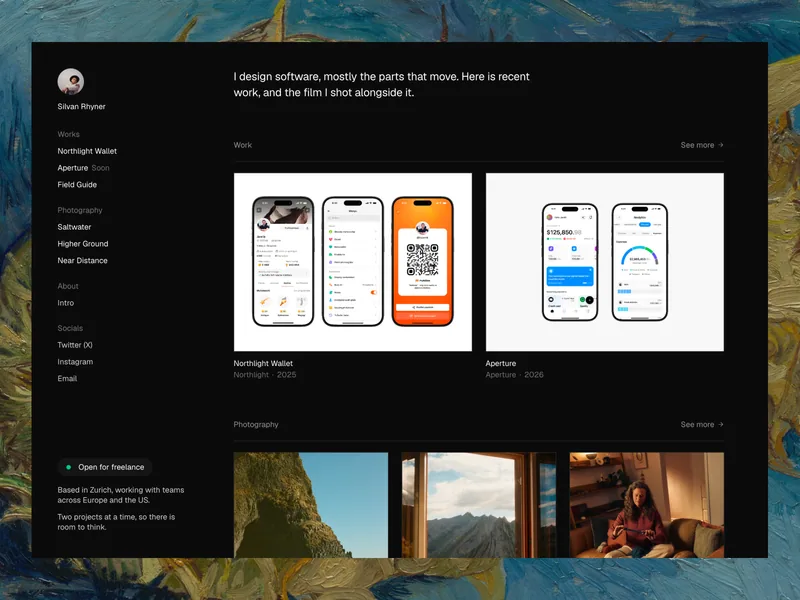
For more portfolio sites and what each does well, read Framer portfolio examples. If you want to start from a layout, Silvan Rhyner is a dark portfolio with a fixed sidebar for client projects and photo series, and Maël Blanc suits designers who want a services table beside their case studies.
Photography examples
Photography has its own page, because the layout choices differ from other portfolios. Photography portfolio website examples sorts live Framer sites by layout, and the photography portfolio how-to walks through building one.
For templates, Halvor is a white portfolio for studio photographers with a sphere of images on the home page, and Léon Varet is for photographers who work in series.
Film and video examples
Jeremie Bouchard’s site (jeremiebouchard.com) opens with his name and the line “Director + Editor based in Canada”. The menu is Work, About and Let’s Connect, and the work list names each project with its type and year. Paulina Kowol’s site (paulinakowol.com) is a director of photography’s portfolio, and it is shorter still: a projects menu, a contact link, her city and a list of titles.
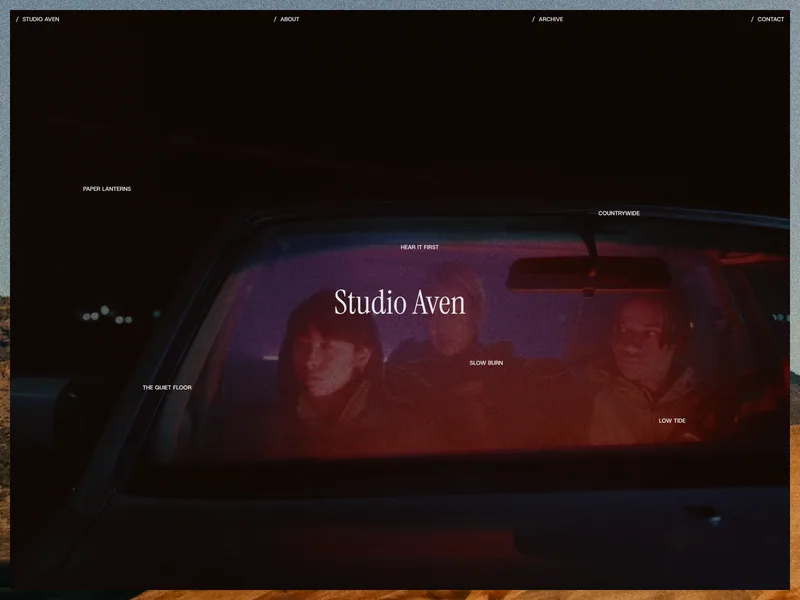
My guides cover the practical side: filmmaker portfolio with a showreel, the videographer checklist and templates for video editors. For a production company, Studio Aven is a dark template with a full-screen showreel and a filterable film archive.
Agency and studio examples
Studio Noun (studio-noun.com) calls itself a boutique creative studio. Its home page lists four services: brand identity, web design, web development and creative direction.
The longer review is Framer agency website examples, and Framer agency templates compares the templates. Three to start from are Rosetta, a one-page template for brand studios, Mason for freelancers and small agencies, and Roster Studio for design studios.
Architecture, real estate and consulting examples
This is ground my other guides do not cover yet.
Kazoda (kazoda.co) is an architecture portfolio. Its home page has an About text and a filter with All, Architecture, Scenography and Journal, followed by named projects. Impey Studio (impey.studio) is an interior design studio, and its home page says it creates interiors for cultural and hospitality spaces.
For templates, Maison Architect has a video hero, case studies in six photo layouts and a journal. Belmont is for real estate agencies and developers, and Westport is for consulting and advisory firms. I did not find a Framer-built live example for real estate or consulting that I could confirm, so for those two I point to the templates only.
Which type to start with
The right starting point depends on what the site has to do.
| If your site is mainly | Start here | Free template |
|---|---|---|
| A body of personal work | Portfolio examples | Silvan Rhyner |
| Photographs in series | Photography examples | Halvor or Léon Varet |
| A showreel and credits | Film and video examples | Studio Aven |
| A studio selling services | Agency and studio examples | Rosetta |
| Projects, a journal and a team | Architecture examples | Maison Architect |
The templates in this table use between 1 and 6 CMS collections, so check the fit against your plan before you commit. The CMS table in my pricing guide lists them.
What the best examples have in common
Across the sites above, a few things repeat:
- The first screen says who the person or studio is and what they do
- The work or the services are listed by name, not hidden in a menu
- Contact is in the menu or one click away
- The copy is short, so the work carries the page
This is my reading of these examples, not a study. Framer’s own blog says to lead with three to six of your strongest projects, with short context for each, and I agree with that as a starting point.
How to read an example before you copy it
Open it on your phone before you copy anything. Then check three things.
First, load time. A page that opens slowly on a phone will lose visitors whatever its design. Second, whether it started from a template. Many Gallery pages do not say, so treat the layout as a pattern, not a recipe. Third, what the CMS holds. A layout that needs five collections will not fit on a plan that allows two.
On October 26, 2026, Framer Basic listed 2 CMS collections and Pro listed 10. My Framer pricing guide has a table of how many collections each free template uses.
Where to find more
These places list Framer sites, in no order:
- The Framer Gallery, sorted by category
- The Awwwards Framer list, Awwwards’ list of Framer sites
- BuildinFramer, a curated gallery of live Framer sites by category
- SiteBuilderReport, a list of Framer sites with short entries
FAQ
Where can I find Framer website examples?
The Framer Gallery. On October 26, 2026, it listed categories including Agency, Portfolio, Art, Design, Film, Architecture, Real Estate, Consulting, SaaS and Ecommerce.
What kinds of websites can you build with Framer?
Portfolios, agency sites, product sites, ecommerce pages, publishing and place-based sites, going by the Gallery’s categories. It covers far more than portfolios. The categories also include education, nonprofits, health and hospitality.
How much does a site like these cost?
A site can publish for free on a Framer address, and a custom domain needs Basic at $10 per month on yearly billing. Framer calls the Free plan ideal for non-commercial use, so plan on a paid plan for a business site.
How many projects should a portfolio show?
Framer’s own blog says three to six strong projects. How many you show depends on the work, and cutting is usually the harder part.
Can I see a template live before I use it?
Yes. Each template page here has a live preview and a free download button, and Framer’s marketplace pages have previews too.
Can I build a site like these without code?
For layout, CMS content and forms, yes, because the templates are edited visually and Framer includes hosting. Custom code exists in Framer, and some effects need it. I would start from a free template, replace the sample content with your own, and add custom code only if a specific effect needs it.